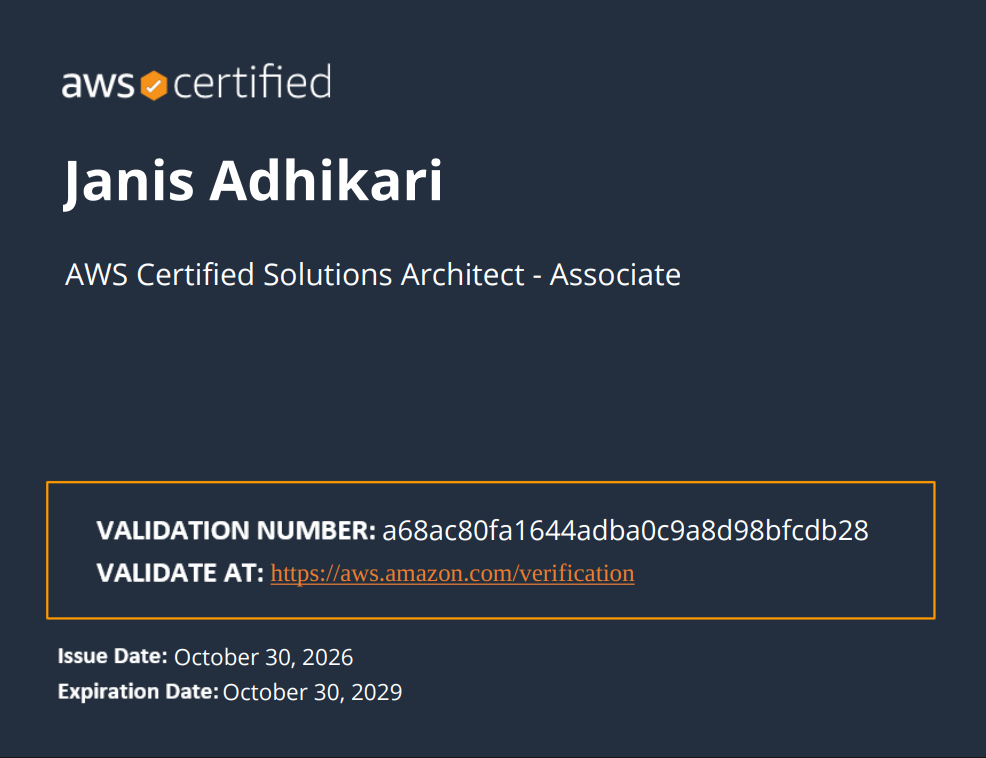
🎓 My Certification

View my AWS certification on Credly →
How I Passed the AWS Solutions Architect – Associate (SAA-C03): My Preparation Journey
On October 30, 2026, I passed the AWS Certified Solutions Architect – Associate (SAA-C03) examination, achieving my first professional cloud certification.
This is an important milestone in my journey toward DevOps and cloud engineering. Over time, while learning DevOps, cloud infrastructure, and automation, I have explored different AWS services and incorporated them into several of my personal projects.
Preparing for this certification gave me an opportunity to strengthen that knowledge, understand AWS services from an architectural perspective, and learn how to make better infrastructure decisions.
In this article, I want to share my preparation journey, the resources I used, my mock examination strategy, and a few lessons I learned along the way.
1. My Background with AWS
My exposure to AWS started before joining the apprenticeship. While learning DevOps and cloud technologies, I explored AWS services and incorporated them into several of my personal projects.
Through these projects, I gained practical experience working with services such as Amazon S3, CloudFront, Lambda, DynamoDB, and API Gateway. I also explored infrastructure provisioning and automation using Terraform.
These hands-on experiences helped me understand how AWS services could be used to deploy applications, manage infrastructure, and build cloud-based solutions.
Later, I joined the AWS Cloud Apprenticeship by AWS Pathway (Karnovation), which provided an opportunity to strengthen my existing knowledge through a more structured learning approach.
Over two months, the program covered cloud fundamentals and progressed toward the concepts required for the Solutions Architect – Associate certification. It also provided structured learning materials, sandbox lab environments, and exposure to AWS services through the Cloud Foundations and Solutions Architect learning paths.
One thing I particularly appreciated was the opportunity to revisit concepts I had previously encountered and understand them from an architectural perspective.
My existing practical experience helped me connect the learning materials with real implementation scenarios.
This also changed how I approached AWS learning. Rather than simply understanding what a service does, I became more interested in knowing when to use it, why it is appropriate, and how it fits into a larger cloud architecture.
2. My Exam Preparation Strategy
For my dedicated certification preparation, I followed the AWS Pathway certification track.
Learning resource: AWS Pathway
I generally dedicated around one hour per day to studying, completing the learning materials and quizzes alongside the lessons.
Rather than switching between multiple courses and resources, I decided to follow one structured learning path and complete the material across all four SAA-C03 exam domains.
My preparation approach was straightforward:
- Complete the learning materials for all four exam domains.
- Attempt the quizzes alongside each lesson.
- Identify services and architectural concepts I didn't fully understand.
- Keep track of incorrect answers and revisit those topics.
- Use ChatGPT to clarify confusing AWS concepts and understand the reasoning behind quiz answers.
I focused on understanding the architectural reasoning behind each answer rather than memorizing service definitions.
For example, knowing what Amazon S3, EBS, and EFS are is one thing. Understanding their differences, storage characteristics, access patterns, and appropriate use cases is what helps when solving scenario-based questions.
Following a structured learning path helped me stay consistent and avoid spending too much time jumping between different learning resources.
3. The Final Three Days: Mock Exams and Reviewing Mistakes
The final three days before my examination were dedicated almost entirely to mock tests and revision.
I completed at least seven mock examinations, with my scores generally ranging from 700 to 850.
However, I don't think taking mock exams alone contributed the most to my preparation. The real value came from reviewing the questions I got wrong and understanding why my selected answers were incorrect.
Whenever I answered a question incorrectly, I maintained notes covering:
- The important details and requirements from the question.
- Keywords that influenced the architectural decision.
- The correct answer.
- Why that particular solution was appropriate.
- Why the other options were less suitable.
I also used ChatGPT to break down complicated scenarios, compare AWS services, and clarify concepts that I found difficult to understand.
This approach helped me recognize patterns in scenario-based questions and become more careful about identifying the actual requirements.
For example, a question might ask for a highly available solution, but that doesn't automatically mean choosing the most complex architecture. Requirements such as cost, operational overhead, recovery time, and fault tolerance can significantly influence the appropriate solution.
I gradually started paying more attention to these details.
My biggest takeaway from mock exams was that reviewing mistakes is more valuable than simply chasing higher scores.
4. What I Would Do Differently
Although I'm happy with the result, there are areas where I believe I could have prepared better.
One area I would particularly focus on is Designing Resilient Architectures.
If I were starting my preparation again, I would dedicate more time to implementing and experimenting with AWS architectures rather than relying primarily on theoretical learning and practice questions.
Coming from a DevOps learning background, I believe hands-on implementation is especially valuable.
For example, instead of only studying high availability and fault tolerance, I would build small architectures and experiment with:
- Deploying applications across multiple Availability Zones.
- Configuring Application Load Balancers and Auto Scaling Groups.
- Implementing database backups and recovery strategies.
- Exploring different S3 storage classes and lifecycle policies.
- Configuring IAM policies and security boundaries.
- Monitoring infrastructure using CloudWatch.
Building these solutions would help me understand not only how individual AWS services work, but also how they interact in a production environment.
Passing a certification demonstrates an understanding of concepts, but being able to apply those concepts to real-world infrastructure is what matters in engineering.
5. My Advice to Anyone Preparing for SAA-C03
Based on my preparation experience, here are a few recommendations for anyone planning to take the AWS Solutions Architect – Associate examination.
1. Build a Strong Foundation
Don't rush directly into mock examinations.
Start by understanding cloud computing fundamentals and the purpose of major AWS services. Learn what problems they solve and where they fit into cloud architecture.
2. Follow a Structured Learning Path
Choose a reliable learning resource and complete it systematically.
Having a structured learning path helped me organize my preparation, maintain consistency, and identify topics that required additional attention.
3. Understand Service Differences
Pay particular attention to services that have similar use cases but different capabilities.
For example:
- S3 vs. EBS vs. EFS.
- RDS Multi-AZ vs. Read Replicas.
- SQS vs. SNS vs. EventBridge.
- NAT Gateway vs. Internet Gateway.
- ALB vs. NLB.
- AWS Backup vs. service-specific backup mechanisms.
Understanding their differences and appropriate use cases is essential for architectural decision-making.
4. Treat Mock Exams as Learning Tools
Don't focus entirely on your mock examination scores.
Review incorrect answers, understand the reasoning behind the correct solutions, and revisit the concepts you struggled with.
Your mistakes can help identify exactly where your understanding needs improvement.
5. Pay Attention to Scenario Requirements
SAA-C03 questions frequently describe business and technical requirements before asking you to select an appropriate architecture.
Pay attention to requirements involving:
- High availability and fault tolerance.
- Security and access control.
- Performance and scalability.
- Cost optimization.
- Disaster recovery.
- Operational overhead.
A small difference in the requirements can change which architectural solution is appropriate.
6. Get Hands-On Experience
This is something I would personally prioritize even more.
Experiment with AWS services, deploy small applications, configure infrastructure, and observe how different architectural decisions affect the system.
If you're already learning DevOps, try connecting AWS concepts with tools and practices such as Terraform, Docker, Kubernetes, CI/CD, and infrastructure monitoring.
This makes the learning process more practical and helps bridge the gap between certification knowledge and engineering experience.
7. Understand, Don't Just Memorize
Memorizing answers might help you recognize familiar questions, but understanding the underlying concepts is much more valuable.
Focus on why a solution is appropriate and why the alternatives might not satisfy the requirements.
6. What's Next?
Achieving the AWS Solutions Architect – Associate certification is an important milestone, but I see it as another step in a much longer learning journey.
My primary interest remains in DevOps, cloud infrastructure, and site reliability engineering.
I want to continue improving my understanding of AWS while focusing on practical implementation, infrastructure automation, container orchestration, CI/CD pipelines, monitoring, and reliable application deployments.
I also want to apply what I've learned by building and improving real-world projects rather than limiting my learning to certification preparation.
I'm grateful to the AWS Cloud Apprenticeship by AWS Pathway (Karnovation) for providing the structured learning opportunity that supported my certification preparation.
One certification achieved. More infrastructure to build, more systems to understand, and more problems to solve.
If you're also preparing for the AWS Solutions Architect – Associate examination, I hope sharing my experience gives you a useful starting point.
Keep learning, keep building, and keep experimenting!
Certification
AWS Certified Solutions Architect – Associate (SAA-C03)
View my certification on Credly
#AWS #AWSCertification #SAA-C03 #DevOps #CloudEngineering #CloudComputing #AWSCloud #LearningInPublic